Built around sourcing, customer work, sales, fulfillment and marketing. Austin uses this system in the building-supply operation. These journeys describe the tools and human decisions involved; they do not claim that the operation runs end to end on its own.
Customer lifecycle and follow-up
The buyer problem
An inquiry arrives in one channel while its history and next step live elsewhere.
The trigger
A call, quote request or repeat material need starts a customer conversation.
People and decisions
Sales staff and the owner review the customer; the former receptionist flagged calls for John to follow up.
Connected systems
Customer records combine communications, invoices and lifecycle views. Need, sourcing, comparison, order and repeat need provide the business model for those views.
The output
A customer history and a visible next-action context for the sales team.
Screens ready to demonstrate; intake handoff needs repair or redesign.
Current boundary: The receptionist role ended and lead promotion now needs an owner. Screens and lifecycle counts do not establish a maintained pipeline or automatic transitions; communication consent is separate.
Call routing and a common sales handoff
The buyer problem
Staff need to know where an inquiry came from and who should act next.
The trigger
A caller uses a market-specific number or the main phone workflow.
People and decisions
The caller chooses an IVR path; John receives the sales call. Staff record notes, callbacks or escalation.
Connected systems
RingCentral call-origin records and market-number attribution feed the call workspace. The described routing joins channel-specific numbers to a common IVR and sales workflow.
The output
Call history, source context and callback information alongside business records.
Recorded views and routing design can be shown; live routing needs validation.
Current boundary: Live number forwarding, current IVR settings and completeness of logging need confirmation. Call-source context is not proof of ad attribution or sales conversion.
Supported supplier information into a quote
The buyer problem
Supplier invoices need to become usable sales documents without treating an unfamiliar layout as trustworthy data.
The trigger
Staff supplies an invoice in a supported supplier format.
People and decisions
Staff reviews items, pricing and intended markup. A developer onboards the first unfamiliar format into a reusable parser.
Connected systems
Permanent known-format parsers extract usable items for a branded quote or invoice. The original rough-text quote idea remains constrained by incomplete product data.
The output
A reviewed, marked-up customer quote or invoice from supported source information.
Ready for a supported-format walkthrough using safe sample documents.
Current boundary: Unknown layouts require onboarding and checks; this is not reliable unattended extraction of arbitrary documents.
Quote, order and fulfillment paperwork
The buyer problem
Sales items and customer communication need continuity through ordering and shipping.
The trigger
Staff accepts or edits a quote and prepares an order.
People and decisions
Staff converts the quote, edits invoice items and chooses the customer communication and fulfillment actions.
Connected systems
Quote items carry into orders. The order workspace supports invoice PDFs, payment links, email/text actions and bills of lading.
The output
Customer-facing invoice, payment-provider link and fulfillment paperwork tied to an order.
Ready to demonstrate document preparation with synthetic records; live sends excluded.
Current boundary: Application payment status does not establish bank settlement or reconciliation. DAT freight bidding remains planned.
Supplier offers and closeout drafts
The buyer problem
Time-sensitive offers need pricing, product checks and a usable merchandising package.
The trigger
Supplier mail or a closeout manifest arrives with items and pricing information.
People and decisions
Staff reviews exceptions and closeout drafts; supported deal lanes may publish under their price and photo gates.
Connected systems
Supplier-offer tools support temporary specials separate from evergreen products. Closeout tools support manifest records, marked-up offers, sales sheets and campaign drafts.
The output
A product offer, review item, sales sheet or saved campaign draft.
Draft surfaces can be demonstrated; end-to-end intake needs fresh validation.
Current boundary: October 1 intake freshness and historical closeout linkage were unresolved. The inspected lumber-price branch was preview-only; it does not prove live publishing. Current repair work is separate from this case study.
Product signals into marketing materials
The buyer problem
Staff need to choose products and reuse their information across promotion formats.
The trigger
Staff reviews product engagement and selects products for a campaign or listing.
People and decisions
Staff or an authorized lane chooses products and layout, then determines the permitted publishing or send action.
Connected systems
Product views and simplified reporting inform choices. Studio creates formatted ads and copy; Listing Kit saves platform-specific packages; email drafts use catalog items and public merchandising reads product records.
The output
Creative, email drafts, listing packages and authorized product placements.
Generation and saved packages ready to demonstrate; attribution requires deeper validation.
Current boundary: Engagement is not verified sales attribution. Marketplace packages do not establish automatic posting. Email prices are captured when a draft is built; a stale draft may need rebuilding.
Content publication and scoped agent work
The buyer problem
Agents need enough authority to do useful business work without treating access as blanket permission.
The trigger
An approved assignment or a permitted content lane supplies a bounded task.
People and decisions
The owner assigns work and selects access. Agents operate within their identity and scope; review requirements depend on the action.
Connected systems
The agent pilot supports findings, human assignment, dispatch and evidence-backed outcomes. Austin described a current content lane publishing articles, metadata and images through the operations platform to the public site.
The output
A reviewed finding or completion record, or content published under that lane's gates.
Pilot design and scoped workflow can be demonstrated; deployed authority and content delivery need validation.
Current boundary: The one-key permission design is an open review branch, not established as deployed. Assignment delivery needs a configured receiver. The content lane is user-described use, not a fresh publishing audit or certified SEO outcome.
What this demonstrates
A custom workspace can connect several parts of a business while leaving staff responsible for decisions that need judgment. Agent access is a separate, scoped part of that design. Freight bidding and physical inventory/POS integration remain future work.
The existing redacted captures below show the app surfaces. They are not new end-to-end demonstrations or measured results.
Flagship proof · Building materials · Nashville
Music City Building Supply
Operating system
A workspace connecting customer, supplier and marketing work.
Inbound calls, quotes, supplier pricing and promotions each arrived through their own channel. Whether a customer got followed up depended on somebody remembering.
What I built
ShopBoss brings customer history, calls, quotes, orders, supplier-format parsing, product records and marketing tools into a focused workspace for the building-supply business.
Where it stands
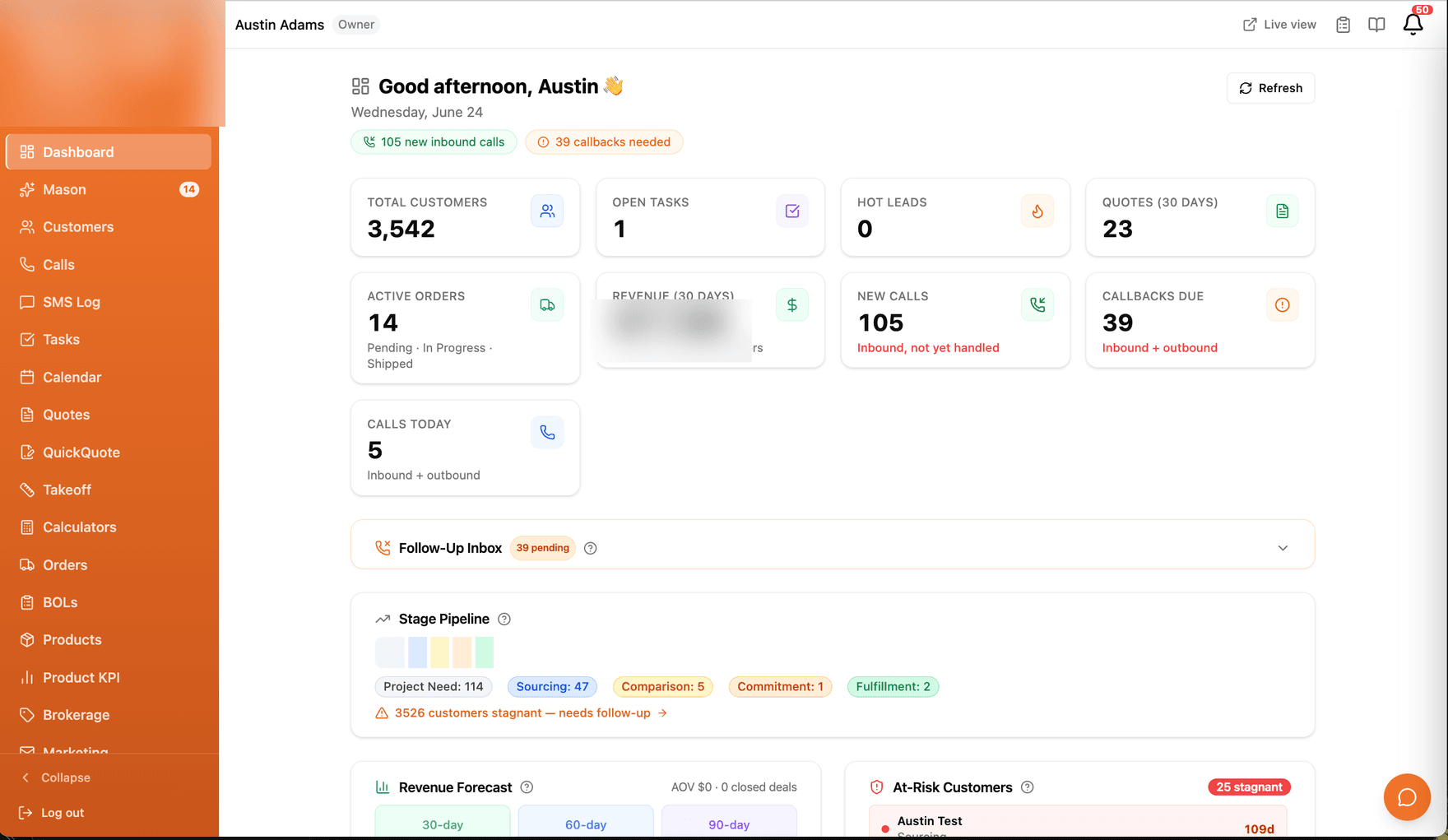
Austin uses ShopBoss for Music City Building Supply. The screens show connected records and tools, not proof that the whole customer or supplier journey runs unattended.
Where a person decides
A person converts each quote into an order and chooses invoice and promotion sends; a live preview and optional test send are available. Supported supplier deals are listed only when they pass price and photo checks; other items are held for review. Current intake coverage needs confirmation.
Express and MongoDB behind a React admin. The API and admin run on a dedicated server; the public storefront is a separate Next.js site and embeddable bundles that read from it.
→What it actually removes
A quote converts into an order with its line items, tax and delivery carried over, and the invoice is produced from that order, so the same items are not re-typed into three documents.
Calls sync from the phone system onto the matching customer record, and missed calls land in a follow-up queue built from those call records rather than a list someone keeps by hand.
Promotion emails are built from catalog items and specials already in the system instead of being retyped. Prices are written in when the email is built, so it is worth rebuilding a draft that has sat while prices changed.
The public storefront reads the same product records the sales floor edits, so there is no second catalog to keep up to date.
ShopBoss — the daily operating view — Customers, open orders, inbound calls and the follow-up queue in one place. Revenue figure redacted.
Which workflow would you connect first?
We agree the deliverables and boundaries in a paid, scoped proposal.